There’s a distinct strand of architectural writing that warns against ‘means-end thinking’, or ‘instrumental thinking’. For example, we might decide that we want to live in a home that has a constant temperature of 22 degrees centigrade, or that has a view to the south-east, or that has at least 120 square metres of area, and with these artificial ends in mind, we go about arranging them; we find the means, whatever and wherever those are in the world’s catalogue. And this—it’s said by some—is a bad way of doing things. The warning extends to architectural types; to think of whole buildings as objects serving our more abstract goals—a research facility, a learning resource centre, a shopping mall—is also to practice means-end thinking. The cost—it’s said—is twofold; the resulting construction will not be worthy of its inhabitants, and worse, through losing sight of what’s said to be our proper goal—to live well, and true to ourselves—we risk “spoliation” of our environment. Instead, architects should aim first at a better rooted relationship with places, with people and with customs of inhabitation and practical purpose. Not housing, schools, factories, but dwellings, workshops and gathering places of the community. Not needs or targets met, but people addressed—so to speak—‘in their authentic being’ (my phrasing). Here’s an example of the message, from Dalibor Vesely:
“Architecture has probably never abandoned completely its humanistic role, though in modern times this role has mostly been improvised. That approach may no longer suffice in a changing world increasingly dominated by instrumentally oriented expectations. To preserve its primary identity and humanistic role in the future, architecture must establish credentials on the same level of intelligibility as instrumental thinking, while at the same time it must integrate and subordinate the instrumental knowledge and the technical potential of human beings to their praxis. This is, in essence, my aim in broad outline …” (Vesely, ‘Architecture in an Age of Divided Representation’ (2004), p. 5)
The terms ‘means-end thinking’ and ‘instrumental thinking’ shouldn’t be taken to say that it is wrong to have a goal in building; instead, the idea in play here is that when our goals become culturally disconnected—when we are tending to do things for the sake of doing them; ‘because we can’, rather than in response to a shared cultural practice that gives our goals meaning—then something has gone wrong. Our thinking has become disordered. We should—so these writers say—try to restore a proper hierarchy of thinking. ‘Humanistic’ thinking (to use Vesely’s term for it) should come first; instrumental thinking should only support.

Can Lis, Jørn Utzon’s holiday house on Mallorca
(1) The farmhouse exemplar
The main point of departure for writers such as Vesely seems to be the later work of the German philosopher Heidegger; what is often called the post-Kehre work (or ‘post-turn’ work), produced for the most part after Heidegger’s own active involvement in German fascism, and after the war.1 In one particular passage, often quoted, Heidegger seems to give us an architectural exemplar:
“Let us think for a while of a farmhouse in the Black Forest, which was built some two hundred years ago by the dwelling of peasants. Here the self-sufficiency of the power to let earth and heaven, divinities and mortals enter in simple oneness into things, ordered the house. It placed the farm on the wind-sheltered mountain slope looking south, among the meadows close to the spring. It gave it the wide overhanging shingle roof whose proper slope bears up under the burden of snow, and which, reaching deep down, shields the chambers against the storms of the long winter nights. It did not forget the altar corner behind the community table; it made room in its chamber for the hallowed places of childbed and the “tree of the dead”—for that is what they call a coffin there: the Totenbaum—and in this way it designed for the different generations under one roof the character of their journey through time. A craft which, itself sprung from dwelling, still uses its tools and frames as things, built the farmhouse.” (‘Building, Dwelling, Thinking’ (1951))
But let’s consider this with a slightly more sceptical mindset. First, does Heidegger give an accurate description? What are these houses really like? Has anything been left out? The phrase “by the dwelling of peasants” strikes: are these real people or archetypes? It’s possible to check Heidegger’s description against a preserved museum house in the Black Forest (shown below) but to encounter a museum house is not to live as its builders lived; to have their experiences or their thoughts. So the second question is: what can a description of a house (or a museum house encounter) really tell us about its builders?
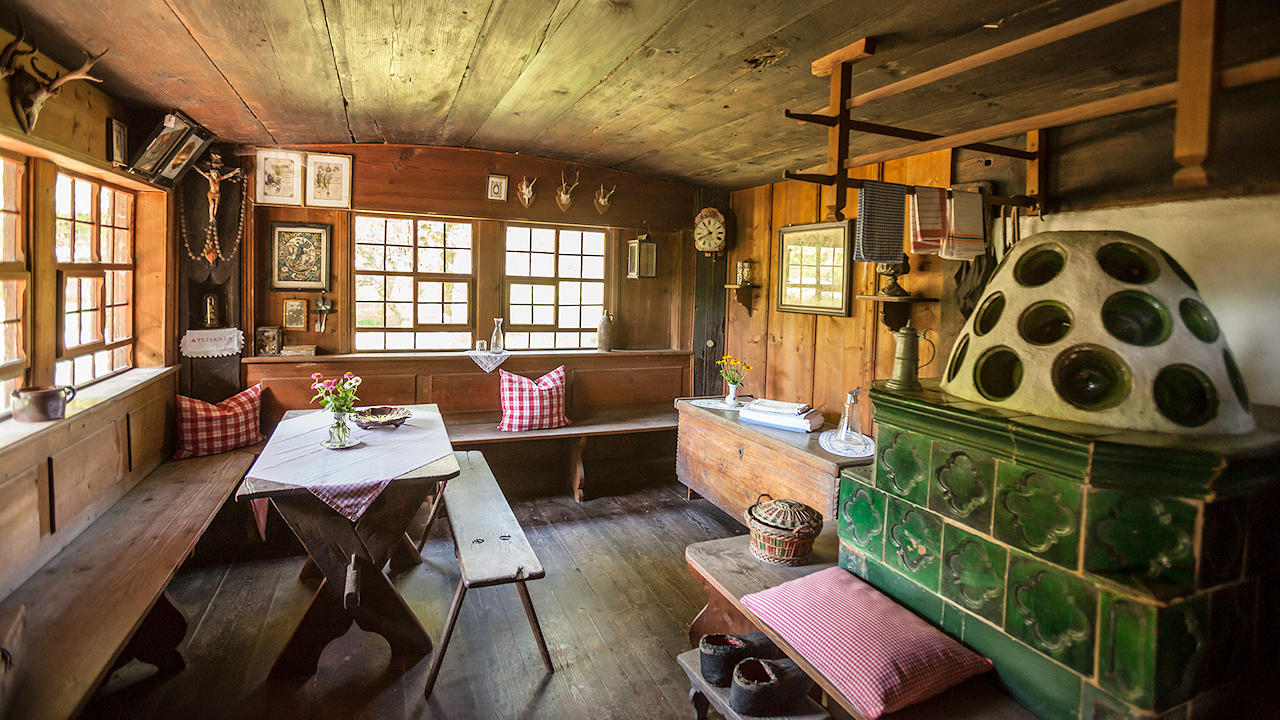
The Black Forest Open Air Museum, Vogtsbauernhof
Here we can do a thought experiment. Let’s assume—provisionally—that such a house, accessed either through Heidegger’s description, or through a preservation visit, does show the thinking of its builders. Heidegger says that these builders dwelt (that is, they thought in a certain way) and that the ‘craft’ of the house (the way it was built) arose from that dwelling. Or in Vesely’s terms, let’s assume the house is an example of humanistic and non-instrumental building, and is thus appropriately culturally connected. But consider the features of the house; it has these gables, those windows, those beams, etc. Are all of these features of the house culturally connected? Are we sure that none of what we see was put into place in deprecated ways? The history of Black Forest houses shows that earlier versions were built with living rooms facing the hillside, and not facing out, over the valley, as we might expect.2 At some time, a switch was made and later examples do have valley-facing living rooms (as the image above shows). But why was this done? Perhaps a Black Forest farmer had the thought that to observe the valley would be pleasant, and asked themselves what would have to happen to bring it about, whatever resource it might require, whatever tradition it might up-end. If so, this change of theirs would have to be described as instrumental. But this is the opposite of what we’ve assumed that the exemplar shows. In other words, it is one thing for a built exemplar to allow us to imagine a history (of human thought and action), it is another for the exemplar to evidence it.
After presenting his exemplar, Heidegger immediately disavows it:
“Our reference to the Black Forest farm in no way means that we should or could go back to building such houses; rather, it illustrates by a dwelling that has been, how it was able to build.”
But this move is problematic too. Let’s concede that we should not—as Heidegger now says—literally construct with oak beams, or roofs of a certain angle, etc. We should not look to the farmhouse for lessons in the how. Instead, we are only to see that the farmhouse was built by people who had dwelling or who dwelt. Perhaps, inspired by the exemplar, we can develop our own route to humanistic building. In that, we would not do something exactly like the farmhouse, but we would do something analogous. But even to develop an analogous way of building requires us to analyse the farmhouse, and for the same reasons just discussed, it seems unsafe to assume that this analysis will guide us right. For every scenario where a farmhouse feature is said to represent a certain cultural connection (this door faces a certain way so as to respect a certain cultural practice) there is a counter-scenario where the same feature came about through deprecated thinking (one farmer happened to think it would be convenient, or more comfortable). So we are caught. It seems that if we want to be inspired to a certain way of building by the farmhouse, we should also ignore it, on pain of being undermined. But are we then being inspired by anything more than our own imagining; what we like to think that the farmhouse represents?
(3) A problem of individual innovation
Let’s say that for this sort of reason we decide to set aside Heidegger’s farmhouse. Where does this leave the project of advocacy for humanistic, non-instrumental building? Writers might perhaps look to Heidegger’s earlier work. There is an invitation, issued very early in ‘Being and Time’ (SZ) (1927), to use the everyday—the things we usually do and say—as a way to gain insight. What is the everyday? Heidegger’s writing certainly evokes an everyday—affirmatively: field, farm and homestead, and also, with some disdain, the modern converse: newspaper, train, factory and apartment—but in the end he does not define the term ‘everyday’ by explicitly pointing to certain sorts of thing. The everyday, in Heidegger, is ‘a way to be’: it is for us to recognise, to admit to. We are to consider that which is ordinary for us. At the same time, we are prompted to consider this dullness in its diversity. For a start, there is that which has ‘phenomenal transparency’. When we use a hammer, we often don’t much notice the hammer itself; it becomes almost part of us. Similarly, we might take the train to work without much noticing the train.
The scope of the everyday—again in ‘Being and Time’—extends to include people: for example, the customers we may serve; we may ask ourselves if our work product is fit for them. Or at a slight remove, we may notice that our day to day world implies the presence of people; we may think that the train we are travelling in seems well suited for passengers in general. These people, in both cases, are Heidegger’s ‘Others’; figures understood as only lightly differentiated from ourselves. There is then ‘the They’; our conventional, mediocre, ‘levelled down’ everyday culture, habitually consumed by us with minimal reflection.3
Not everything within the everyday runs on rails. Sometimes things break; we then notice these things and cast around for ways to fix them, ‘lighting up the world’ in the process, says Heidegger. (SZ ¶16) (Such things are then ‘un-ready-to-hand’, a further category of being.) And sometimes we start to theorise about things (in a Heidegger example: ‘this hammer is heavy’). For Heidegger, this theoretical speculation, through forgetting the ‘place’ of what is zuhanden (ready-to-hand)—through severing the traditional connections to the network of things that is our equipment—is automatically then the business of the vorhanden (present-at-hand) (SZ ¶69). This stipulation contributes to the completion of the ontology of ‘Being and Time’, in that we are given a rule for when a thing tends to pass over from one category of being to another. But this is also where I start to suspect that Heidegger’s distinctions within the everyday only imperfectly describe who we are, and will not do the job he intends. The scheme does not, I think, do justice to our routine creative practice, considered introspectively. Let’s call this a problem of individual innovation.
We clearly do innovate; all of us, at least at some time: the rooms in the farmhouse weren’t always on the valley side. In my experience even the everyday use of things, even the use of hammers, may be creative, and in our creative exploration we may or may not care about place; the rootedness that Heidegger stresses. Creativity often imports from abroad; the far is just as good as the near. While creativity does not defer to context—the context is there to be taken or left—at the same time it is not anti-contextual. There is a non-cognitive aspect to all this: it is not always obvious how behaviour that tries things differently has gotten started. Perhaps we could include this other thing into affairs, in a way that has never been tried before, we may think, having already mentally visualised the other, unrelated thing. It is not a matter of fixing things: we are not just averting loss, or seeking continuity. And although creativity may be informed by theory, or involve some optimising activity, it is not itself theorising or optimising. Nor is creativity something we do resignedly, with “a pallid lack of mood” (SZ ¶71): creativity is done with enthusiasm, it is not everyday or inauthentic in this sense. Last, creativity is not essentially to do with departure from something already established with us, or “something that has come down to us” (SZ ¶74): we are creative from childhood. So it is not authentic (in the Heideggerian sense) either. Creativity just does not, I think, fit cleanly into the Heideggerian system. Yet creativity is, in the more conventional sense of ‘everyday’, an everyday human practice just as the use of things is, or the theory-minded consideration of objects is. It can be considered basic; part of who we are in our first nature; something the phenomenological analytic should begin with.
This is a problem. Why so? The project of humanistic or non-instrumental building looks to be a project of reform; of ourselves, of our communities. But how can this reform be carried out if it goes very strongly against the grain of our natures? If the creative impulse—just the thought of trying something in a different way—is something basic, something with us from birth, we are almost compelled to think of developing it instead of repressing it. But the path Heidegger offers involves repressing it, or even—in what might seem an improper move—denying it; not allowing it its natural place. For Heidegger often writes as if creativity were not basic, something already with us, but something to be arrived at.
“… the sculptor uses stone just as the mason handles it in his own way. However, he does not use up the stone. That happens in certain ways only where the work miscarries. Of course, the painter also uses pigment, yet in such a way that the color is not used up, but rather first comes to glow. Of course, the poet also uses the word, yet not as ordinary speakers and writers who must use up the words, but rather so that the word first becomes and remains truly a word.” (‘The Origin of the Work of Art’ (1950))
Heideggerian creativity looks to be a matter of mastery. Its pre-requisite is a mature appreciation of our situation; a recognition of its possibilities. Once this is achieved, we use our judgement to select, with skill and resolve, from the possibilities before us. If the creative activity is to amount to art, its proper aim is truth. And—or so Heidegger seems to imply—whatever activity we might be engaged in before we have this mastery is not creativity; perhaps Heidegger might assign what I’ve described as the creative impulse to curiosity, or novelty-seeking. But this vision is profoundly restricting. I seriously doubt it is a vision that a person who works to cultivate their creative impulse can be comfortable with. Creativity wants, or wants at the very least the option of: surprise, shock, untidiness, juxtaposition, contrast, rawness. And—as in the Picasso truism—it wants to retain, or even free, the child in us.
(4) A problem of specialisation
There is a second problem to do with innovation and change. Certainly Heidegger’s everyday tends to the conventional (indeed, our recognition of the conventional is key). Hammers, in Heidegger, are for hammering nails. Thread is for sewing. Leather is for leather clothing. Still, we may decide to set about changing things. And when we set about this change, we may do so with a compelling abstract goal, the thing some say we should not do. But it’s worth thinking about why we would have such an abstract goal. I’d suggest that the answer to this is simply: not only are we the people we are, we are members of a society, and we know it. Our abstract goal-setting is not just a lapse.
Why? We live in large, complex, societies in which it is difficult—and sometimes impossible—for any individual to have full sight of the interplay of production. We specialise, and in doing so our personal goals become somewhat simplified, and abstract. We will likely have very good sight of the challenges that are in front of us, and so we will aim to address them. At the same time, we may have poor sight of the means and ends of our actions; what we will draw on, and how the results of our efforts will fit. Nonetheless, we act. But it seems that this may lead to an attempt to order nature: the thing that Heidegger deplores. In acting in this way, as specialists, we will be directing the world’s stuff as a resource—in the process we might even become a sort of resource. Let’s call this a problem of specialisation: even if, as the Heideggerians say, it is desirable in principle for us as individuals to take on the appropriate degree of rootedness in our actions, in practice—since we are who we are, and we are acting within a collective—we often do not do so. Instead, we often adopt a more limited view of things; we become somewhat unrooted; we allow ourselves to be, so to speak, ‘part of something bigger’: indeed, we often think this is very much worthwhile.
For example, the photovoltaic effect was demonstrated in the nineteenth century but was not developed into a practical technology until the 1950s. Even then, the solar cell was not used for power generation until it was fitted to a satellite several years later. The developers of orbital vehicles wanted a way to make electricity in space, and solar cells were available (alongside other technologies—i.e. resources—such as fuel cells and radioisotope generators). The idea to use photovoltaics as a renewable energy source, making a contribution to the elimination of carbon fuels, followed several years after that. In this history, the discoverer of the photovoltaic effect likely acted (arguendo, I do not know Edmond Becquerel’s real motives) out of a joy of discovery, and perhaps with a vague idea of amelioration. What we can say for sure is that Becquerel had no notion of global warming; his discovery of the photovoltaic effect did not in any sense arise from the goal of securing our shared habitat.
Now it is true that Heidegger is admired for his environmentalism, something that became overt in his later writing. This admiration has grown over time as the significance and extent of global environmental damage has developed. Adorno, writing in the post-war period, before environmental concerns were widespread, identified a conservative or reactionary quality in Heidegger (‘The Jargon of Authenticity’ (1964)). For Adorno, the ‘aura’ that attaches to authenticity in Heidegger tends to mask its reactionary status; the way that it wants to keep everything the same.5 But sometimes, clearly, it may be better to ‘keep things the same’, as in the case of preserving the world’s ecosystems. However, Heidegger’s environmentalism is founded in his picture of authentic life: that we face problems with the environment is, at least up until now, because we live inauthentically. This is how our history has worked out for us, he says. This is how we have turned. It does not matter that we might still be able to fix it: it is not a matter of revising our use of technology. It is important to see here how thoroughgoing Heidegger’s attitude is. As Hubert Dreyfus points out (‘Heidegger on the connection between nihilism, art, technology, and politics’ (1993)) for Heidegger, the implementation of an inauthentic (i.e. technological) fix for environmental harm would be a yet worse outcome than the environmental harm itself. Dreyfus quotes Heidegger:
“What threatens man in his very nature is … that man, by the peaceful release, transformation, storage, and channeling of the energies of physical nature, could render the human condition … tolerable for everybody and happy in all respects.” (‘Poetry, Language, Thought’ (trans. 1971))
So is the Heideggerian view really the place on which we wish to found our environmentalism? Heideggerians insist that no Luddism is intended; that it is only a matter of subordinating technology to the goals arising from lives correctly lived. But we start from where we are. As with creativity, there is real joy in discovery and speculative work. Even though discovery and speculation may create a resource, it seems perverse to insist that every Edmond Becquerel should direct his or her activities with correct, non-instrumental thinking; if we did insist on it, would we ever have the benefit of their activity? As with Heidegger’s creativity, what the Heideggerians describe seems a poor fit for human impulses as we find them. Would human affairs directed along their lines leave us with any technology to subordinate? Is the reform in any way feasible? Could we bear it?
And indeed we have other ways to found our environmentalism or our other core aims. For example, if we see our environmentalism in terms of justice—that is, we face a task of resetting policy away from capture by certain interest groups—we will not need to go along with Heidegger. We will not need to see the challenge of sustainability in terms of our own supposed wrong thinking.
Conclusion
Some architectural writers seem to work backwards from ‘Building, Dwelling, Thinking’—finding the scene of a simple (if also sensual) life presented there appealing—to Heidegger’s earlier writing. In working backwards, they first support his normative demands (i.e. we should reduce our tendency to pursue abstract goals), they assign to those demands significant importance ‘because Heidegger’, and only perhaps as a last step (if at all) they internalise a Heideggerian ontology. I’d suggest that practitioners do not try to follow this path: it does not seem a happy one. Instead, they might pursue something we could call a ‘mindfulness approach’, or even a ‘psychology of Heidegger’. In this, we pay careful attention to our situation on the grounds that our engagement in this frame of mind is often good, happy and productive. But there is no need to seek the stamp of theoretical authority for architectural work through the output of Heidegger or some other writer.
We can further agree that our pursuit of certain goals is often unsatisfactory and destructive. Here, though, I think more caution is needed since the stakes are higher. We do not live and work in a world made only by us, or even by those near to us; we live together with millions of people, all working in specialisms, generally working in good faith, and creatively. In this collective of societies it is not always possible to have full overview of any given chain of processes. Nonetheless, we do find that parts of this diversified output can be successfully—if sometimes unexpectedly—imported into building, or in service of the environment. For example, someone has researched how air leaks from buildings, making the task of heating them harder; it is hard to see the goal-setting that has been done here as other than desirable thinking, and perhaps, in this moment, the most desirable thinking. Beyond individual buildings, someone has researched the effects of certain approaches to urban planning, to transport planning, also with lessons for the way we build and for the environment. Even as we retain traditions—if we retain them—we may choose to modify them: rationally, imaginatively, instrumentally. Or we may choose to abandon them: again, rationally, imaginatively, instrumentally. Wherefore then a hierarchy of thinking?
(This is a substantial re-write of an earlier post from 2018.)
1. Heidegger’s anti-Semitism was categorically established in 2014 with the publication of his private journals.
2. See Hermann Schilli, ‘Ländliche Haus und Hofformen im alemannischen Gebiet Badens‘ (1951).
3. The They (das Man) represents Heidegger at his most seductive and the passages where the idea is introduced seem almost guaranteed to produce an ‘a-ha!’ moment. But the They is also an aspect of ‘Being and Time’ in which the historical and cultural context (Weimar Germany) overtops the author’s effort to make the work timeless. Compare the They with, for instance, a deeply pessimistic passage in Spengler’s contemporaneous (and very widely read) ‘Decline of the West’ (1923): “The people reads the one paper, ‘its’ paper, which forces itself through the front doors by millions daily, spellbinds the intellect from morning to night, drives the book into oblivion by its more engaging layout, and if one or another specimen of a book does emerge into visibility, forestalls and eliminates its possible effects by ‘reviewing’ it”. ‘Being and Time’ seems distinctive to me in that it aims to systematically incorporate mood into its description of the human situation. For example, anxiety is said by Heidegger to provide an opportunity or even a prompt for philosophical reflection. Nonetheless, you suspect that the author, perhaps like Spengler, was disadvantaged by the state of the psychology of the time. The idea that mood (or emotion) might produce cognitive distortion looks to be missing. And it is hard to read Heidegger’s description of the They (or Spengler) without seeing a cognitive distortion. The media and our media habits may be bad, but are they that bad?
4. It’s claimed by Heidegger (SZ ¶38) and others that no hierarchy is intended in Heidegger’s picture of authentic life; that it is not necessarily better to live in resolute, purposive engagement with our equipment, or worse to live in a state of ‘falling’, rehearsing the received views of the mediocre the They. But this cannot be taken too seriously. The tenor of Heidegger’s output says the opposite. We are called by him to recognise our adriftness in the everyday and to step beyond it. Indeed, the later Heidegger is very clear that when it comes to the use of technology in particular, our inauthentic practice of treating things of the world as standing-reserve—as resources to be ‘ordered’ or ‘set in order’ in service of abstracted goals—is deplorable. At the very least enough Heidegger-inspired writers—such as Vesely, quoted at the beginning of this piece—have taken a stance such that we must question the idea that there is no hierarchy in Heideggerian authenticity.
5. The French philosopher Emmanuel Faye goes further, and identifies Heidegger’s philosophy as fascistic both in its inspiration and in its working through (‘Heidegger: The Introduction of Nazism into Philosophy’ (2009)). Faye repeatedly draws attention to ¶74 of ‘Being and Time’, which talks of an authentic collective Dasein, indifferent to both the past and “progress”, that will discover itself in a “moment of vision”.


